
Checking Criminal History in Clarksville
Choose the custodian by record type. Clarksville Police keeps reports for incidents it handled inside city limits. City Court keeps ordinance and traffic case records. The Montgomery County sheriff holds county jail booking data, while the Circuit Court Clerk maintains General Sessions and Circuit case files. TBI supplies the statewide fingerprint-supported name-check layer. Each channel answers a different question.
- Identify the agency from the report number, citation, or incident header before requesting a Clarksville police record.
- Ask CPD Records for a city incident or crash report, or submit a request through the city Public Records Center.
- Search Clarksville Municipal Court by name or citation number for a city ordinance or traffic matter.
- Use the Montgomery sheriff roster for jail custody and county TnCIS for state-law charges and dispositions.
- Use TBI TORIS only when the goal is the official statewide Tennessee name-based history.
No result in one system resolves the others. A CPD report can exist without a municipal case. A person may leave the county jail while a case remains open. A city citation will not turn up through an unsupported municipal portal field.
Clarksville Public Records Center
The city-linked Clarksville Public Records Center is an electronic request channel for city-held records. Its official captured interface appears below.
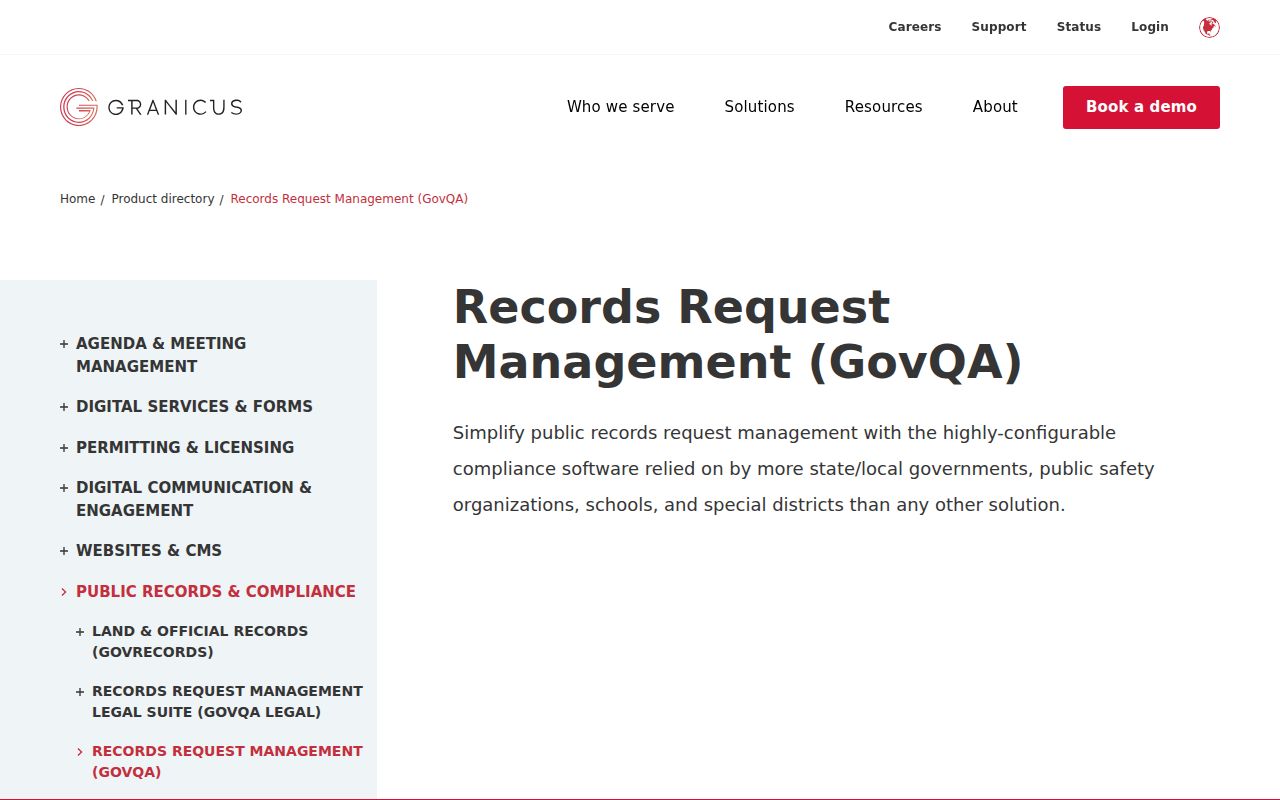
This portal is not the Municipal Court case search. Use it when a city office holds the requested material and an electronic public-record request fits the need. The city's Public Records Request Coordinator works from 1 Public Square and can be reached at publicrecords@cityofclarksville.com or 931-553-2463. Inspection requests may be oral or written, but a request for copies must be written.
Describe the event, date range, record type, and likely office as narrowly as possible. The same street can produce a THP crash, an Austin Peay State University Police matter, an MCSO action, or another government record. The incident header or tracking number is often the best clue. Sending every request to CPD delays the search when another agency made the record.
Clarksville Police Department Records
The Clarksville Police Records Division maintains city-limit incident and crash information at 135 Commerce Street. The counter is open Monday through Friday from 8 a.m. to 4:30 p.m., and the main number is 931-648-0656. For after-hours calls from outside Montgomery County, CPD publishes 931-552-1011. Chief Charles “Ty” Burdine leads the department, but records questions belong with Records rather than command staff.
Start by confirming that CPD created the record. An incident report describes an allegation and police response. An arrest record documents a custody action. Neither supplies the court's final ruling. Active investigation, juvenile, protected-victim, and sensitive identifying information may be withheld or redacted under Tennessee law.
CPD does not provide one county-wide incident pool. For a report created by MCSO, THP, APSU Police, or a federal authority, request it from that agency. The city portal is a request tool, not proof that CPD owns every Clarksville event record.
Clarksville Crash Record Proof Rules
CPD limits crash-copy access to a driver, vehicle owner, agent, or attorney. A driver or owner presents a driver license. An attorney supplies a representation letter. An agent provides the insurance policy number or a signed agency letter. These are specific city proof rules, not general requirements for every police record.
Allow three to five business days for the Clarksville copy. If another agency handled the crash, Tennessee's official crash report portal may be the proper route. Its online report costs $10 and requires the crash date, county, driver names, and agency tracking number. The download remains available for 48 hours, and the state says the fee is not refundable. Tennessee Highway Patrol also lists a $4 in-person or mail route, with mailed reports estimated at two to three weeks.
Note: A crash report records the collision investigation; it is not a Clarksville criminal court disposition or a county jail record.
Clarksville Arrests and Bookings
CPD creates its arrest report, but Montgomery County's sheriff operates the jail. No official city arrest blotter was found, and no separate Clarksville jail was established in the reviewed sources. When a city arrest results in county jail custody, check the sheriff's Jail/Booking Log at 116 Commerce and confirm a possible match with the Inmates Division. The roster is a current-custody tool, not proof of guilt.
A practical trail has several parts. Obtain the incident or arrest report from CPD. Read booking and bond data through MCSO. Then check the court that received the charge. City ordinance and traffic matters go to Municipal Court, while Tennessee-law criminal charges proceed through General Sessions and, for felony indictments, Circuit Court. County booking depth is available through the Montgomery County arrest lookup.
A name may disappear from the live roster after release even though the report and court file remain. Likewise, a booking charge can change when prosecutors file, amend, dismiss, or resolve the case.
Tracing Clarksville Booking Records
First ask who made the arrest. CPD, MCSO, THP, APSU Police, and federal officers can each create distinct source records in or near Clarksville. Second, search the sheriff roster by first and last name. If only one name is known, the official portal instructs users to put a dash in the unused field. Treat every result as a possible match.
Third, request the arrest report from the creating agency. Fourth, allow time for the charge to reach the proper court and search the relevant docket. The county TnCIS system covers General Sessions and Circuit criminal records from November 1, 1999 forward. Older or certified files go to the Circuit Court Clerk. A person seeking the case's filed charges, events, outcome, and sentence can use the Montgomery County criminal court cases route.
Finally, TORIS is the $29 Tennessee repository name check based on fingerprint-supported arrest cycles. It is Tennessee-only and does not include aliases in its public matching process. That state product stays at one-paragraph depth here because a Clarksville report or city citation begins with the local custodian.
Municipal Court Records in Clarksville
The Clarksville Municipal Court hears city ordinance matters, including traffic and code violations. It does not try felony prosecutions. The court begins at 8 a.m. Tuesday through Friday, with no Monday court. Chief Clerk Ernie Griffith maintains records and payments. City Judge Charles W. Smith may issue municipal warrants and subpoenas, but the judge will not privately discuss a pending case before court.
| Court | Clarksville Municipal Court |
|---|---|
| Case types | City ordinance, traffic, and code violations, not felony trials |
| Online search | Name or citation number through Municipal Record Search |
| Clerk | 1 Public Square, Suite 122; 931-648-4604 |
| Sessions | 8 a.m. Tuesday through Friday; no Monday court |
| Copies and fees | No official fee was located; ask the clerk |
The clerk office is open Monday through Friday from 7:30 a.m. to 4 p.m., with payment windows closing at 3:45. The courtroom at 106 Public Square is a different location from the clerk counter and from the county Courts Complex.
Search Clarksville Court Records
The official Clarksville Municipal Record Search exposes only two live search choices: Name and Citation Number. Choose Name and provide the required first and last name, or choose Citation Number and enter that identifier. Then submit the search.
| Field | Type | Required | Notes |
|---|---|---|---|
| Search By | Dropdown | Yes | Name or Citation Number |
| Last Name | Text | For name search | Exact format not stated |
| First Name | Text | For name search | No extra option shown |
| Citation Number | Text | For citation search | Use the number on the citation |
| Search | Button | No | Submits the selected query |
Dormant page-source terms do not expand the live options. Do not expect searches by docket, police case number, warrant, plate, or VIN. If the supported fields return nothing, call 931-648-4604. The court also has a separate route for upcoming docket information.
Clarksville Court Record Visit
A records visit requires the right door. Court sessions are held at 106 Public Square, but the clerk works at 1 Public Square, Suite 122. The county Circuit Court Clerk is elsewhere at 2 Millennium Plaza. Municipal case questions and copy requests go to the city clerk, not to the judge and not to the county criminal desk.
Before entering the courtroom, leave prohibited items elsewhere. Clarksville lists backpacks, electronics, cameras, recorders, fanny packs, glass, knives, razors, mace, pepper spray, and weapons. Accessibility questions can go to ernie.griffith@cityofclarksville.com. Calling first is sensible when the request concerns copies, because the research found no published city search or copy fee.
This address split reflects downtown Clarksville's compact justice geography. Commerce Street houses CPD Records and county custody functions, Public Square holds city government and Municipal Court, and Millennium Plaza holds the county trial-court clerk.
Where Clarksville Records Go
City police reports stay with CPD, but a Tennessee-law prosecution moves into Montgomery County's courts. Fingerprint-supported arrest cycles and later reported dispositions feed TBI's central criminal-history repository. City ordinance cases remain in Municipal Court. These are parallel paths, so the destination depends on the legal basis of the charge.
Record flow: Clarksville Police Department › Montgomery County Courts › Tennessee Bureau of Investigation
For recent activity, start with the creating police agency and county booking channel. For an ordinance citation, use Municipal Court. For state-law case events and the outcome, use General Sessions or Circuit TnCIS and the clerk. For a statewide repository history, use TORIS. A city report cannot substitute for the judgment, and TORIS cannot supply the full local docket.
That route also explains timing gaps. The report can exist before court filing. Jail custody can end before disposition. A clerk's dismissal may take time to appear in a later repository product.
Clarksville Record Trends in Context
Clarksville's official 2025 annual report compares 2022 with 2023. Calls for service rose from 142,899 to 167,765, while incidents fell from 12,145 to 11,994. The incident rate moved from 69.50 to 65.93 per 1,000. The report labels another measure “arrests/cleared,” rising from 3,537 to 4,787, and gives percentages of 29.12 to 39.91.
Keep the source's mixed label intact. A call is not the same as a crime. An incident is not the same as a conviction. The “arrests/cleared” line should not be silently recast as one or the other. These totals describe police workload and reported outcomes at city scale, not an individual's record or a forecast for a block.
Population grew as well. The official Census comparison gives a 2025 estimate of 188,829, compared with 166,722 in 2020 and 132,929 in 2010. Raw service totals need that growth context.
Clarksville Criminal Records Geography
Clarksville is Montgomery County's only incorporated city. The official county profile connects the city and county history, and its captured page appears below.
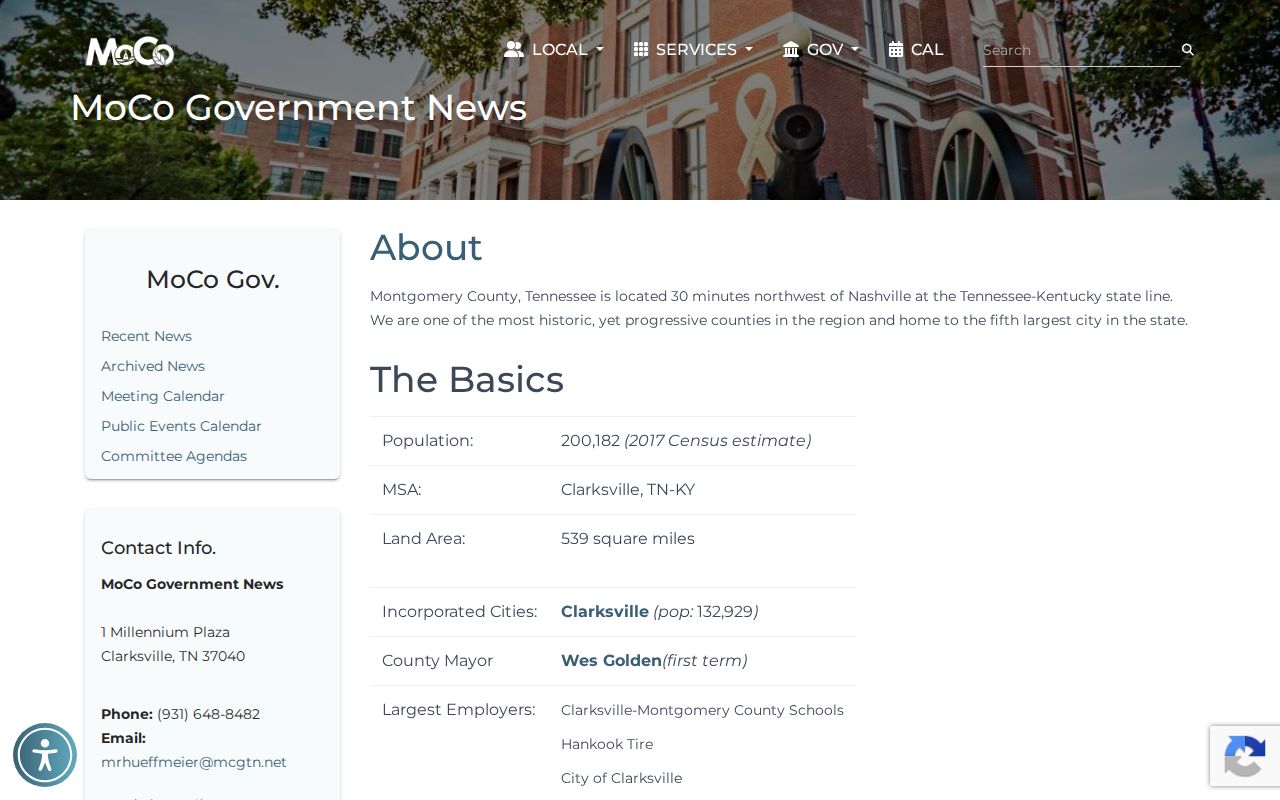
The image supports why no second or third city guide appears in the site's city list. Named communities elsewhere in Montgomery County are not incorporated cities and should not be given invented municipal police or court channels.
Clarksville was founded in 1785, became the county seat in the statehood-era division, and traces its police roots to 1794. River, farm, and tobacco commerce shaped the older downtown. Modern record offices still cluster near Public Square, Commerce Street, Millennium Plaza, and nearby Second and Third streets. The history is not just color. It helps explain why city police records, city court records, county jail records, and county court files sit close together yet remain under different custodians.
Public Access Rules in Clarksville
The Tennessee Public Records Act generally opens government records to Tennessee citizens unless an exception applies. Clarksville accepts city requests through its coordinator and electronic portal. Police may redact or withhold active investigative material, protected victim data, juvenile information, and sensitive identifiers. Municipal court records are presumptively open under court rules, subject to sealing, redaction, and clerk controls.
Key access laws:
Tennessee Public Records Act implementation explains the citizen-access rule, request process, exceptions, and possible copy or redaction costs in the local setting.
Tennessee Supreme Court Rule 34 makes court records presumptively open while allowing lawful sealing, redaction, and clerk administration.
TCA §37-1-134 limits ordinary public access to juvenile records unless a youth is transferred for adult prosecution under the statute.
A public charge is not a conviction. If an online result is missing, contact the right clerk or record office rather than assume the file does not exist. Older, sealed, expunged, juvenile, or not-yet-entered material may not appear in a public portal.