
Montgomery County Criminal Court Cases
Montgomery County divides criminal work by stage and charge level. General Sessions hears misdemeanors and handles initial appearances and preliminary felony matters. A felony indictment then moves into Circuit Court of the 19th Judicial District for arraignment, motions, plea or trial, judgment, and sentence. The Circuit Court Clerk is the record custodian for both of those county tracks. That makes the clerk the sound place to ask for a docket, charging document, judgment, or certified copy.
Clarksville Municipal Court is separate. It hears city ordinance and traffic matters, not ordinary felony prosecutions. A Montgomery County city citation may therefore be absent from the TnCIS criminal docket. Federal charges are separate again and belong to the Middle District of Tennessee. Start with the court named on the citation, bond paper, summons, or other filing instead of assuming one portal covers every court in Montgomery County.
Montgomery County Criminal Court Tracks
The difference between General Sessions and Circuit Court can explain why a search seems incomplete. Sessions may contain the first appearance, a misdemeanor case, or a felony preliminary hearing. Circuit begins its felony role after a grand jury returns an indictment. Local rules place the Montgomery County grand jury on the first Monday of each month, or Tuesday when Monday is a holiday. New indictments and presentments are then set on selected criminal non-jury dates.
| Court | Montgomery County role | Record to seek |
|---|---|---|
| General Sessions | Misdemeanors and early felony stages | Initial appearance, warrant, hearing, and misdemeanor disposition |
| Circuit Court | Felony indictments and trials | Indictment, docket, motions, judgment, and sentence |
| Clarksville Municipal Court | City ordinance and traffic cases | Municipal citation and city-court disposition |
Both county divisions use the Courts Complex at 2 Millennium Plaza in Clarksville. The sheriff's Courts and Process Division handles court security and criminal process, but the clerk remains the case-record custodian. The Clarksville municipal clerk and courtroom are on Public Square, so the city file has its own counter and search route.
Searching Montgomery County Case Records
The Circuit Clerk's online court-record instructions point readers to free Montgomery TnCIS Web Inquiry and publish the shared sign-in. Its criminal and traffic coverage begins November 1, 1999. A known case number is the best key. Party or name inquiry is also available after login, but the live public gate does not reveal every post-login control in advance. The courts' TnCIS training reference confirms those inquiry modes.
- Open the clerk's instructions and confirm that the matter belongs to Circuit or General Sessions.
- Enter the published username mcgcourts and password courts at TnCIS.
- Use case-number inquiry when that number is known. Otherwise use the post-login party or name mode.
- Read each dated docket event and the disposition for each charge, not just the case caption.
- Contact the Montgomery County clerk for an older file, a document absent online, or a certified copy.
| Field label | Type | Required | Notes |
|---|---|---|---|
| Username | Text | Yes | Clerk publishes mcgcourts |
| Password | Password | Yes | Clerk publishes courts |
| Party/name inquiry | Post-login mode | No | Exact live fields are not exposed before login |
| Case-number inquiry | Post-login mode | No | Preferred unique search; format is not publicly specified |
The county's own TnCIS access page is shown below. It confirms the official route and the date boundary before a reader enters the inquiry system.
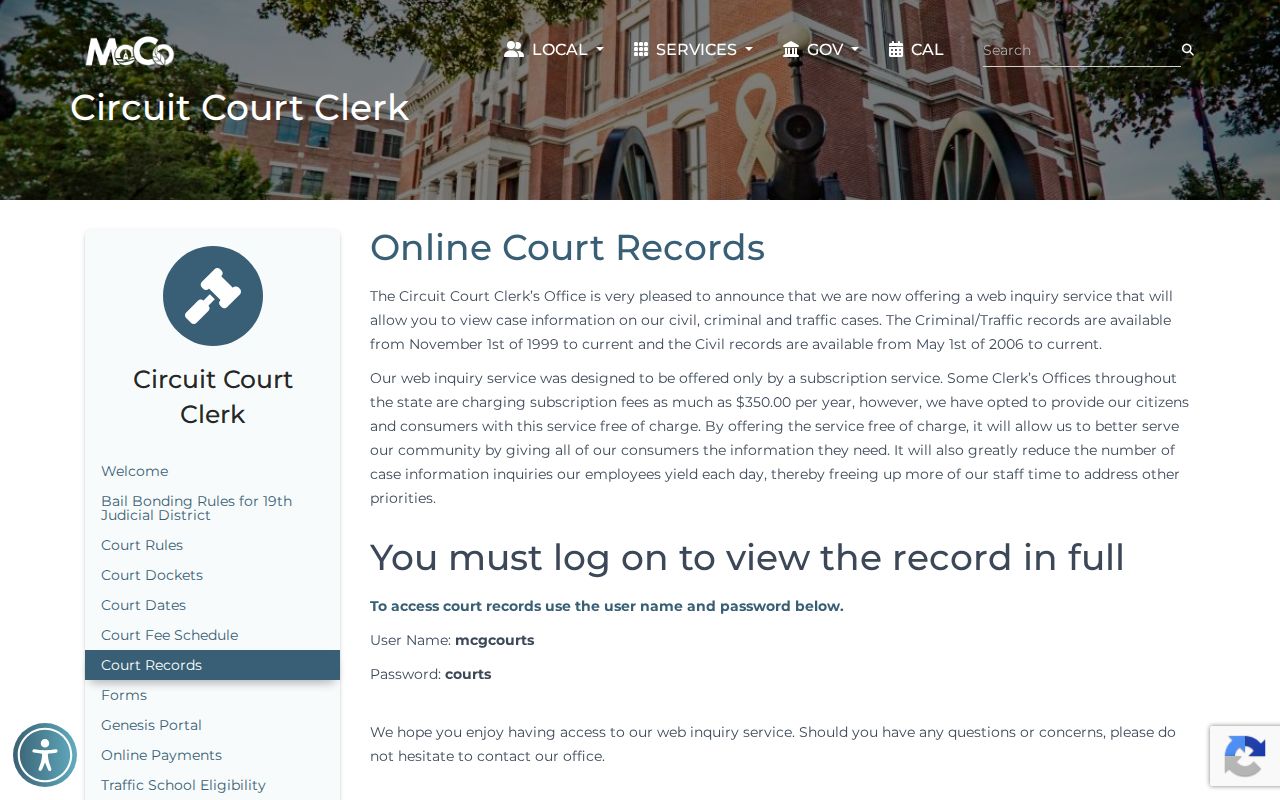
The screen is useful as a checkpoint: trial-court searches should begin with the Montgomery County clerk's link, not an appellate or commercial database.
When Montgomery County Court Search Stops
A blank result does not prove that no Montgomery County court file exists. TnCIS coverage begins on November 1, 1999. Older criminal and traffic matters must be traced through the clerk. A name may also be misspelled, a case may have moved between Sessions and Circuit, or a city citation may live in Clarksville Municipal Court instead. Use the case number and court name from the source document when possible.
The official Montgomery TnCIS Web Inquiry login is pictured below. Once inside, treat each matching name as a lead until the case number, court, and charge details confirm the right file.
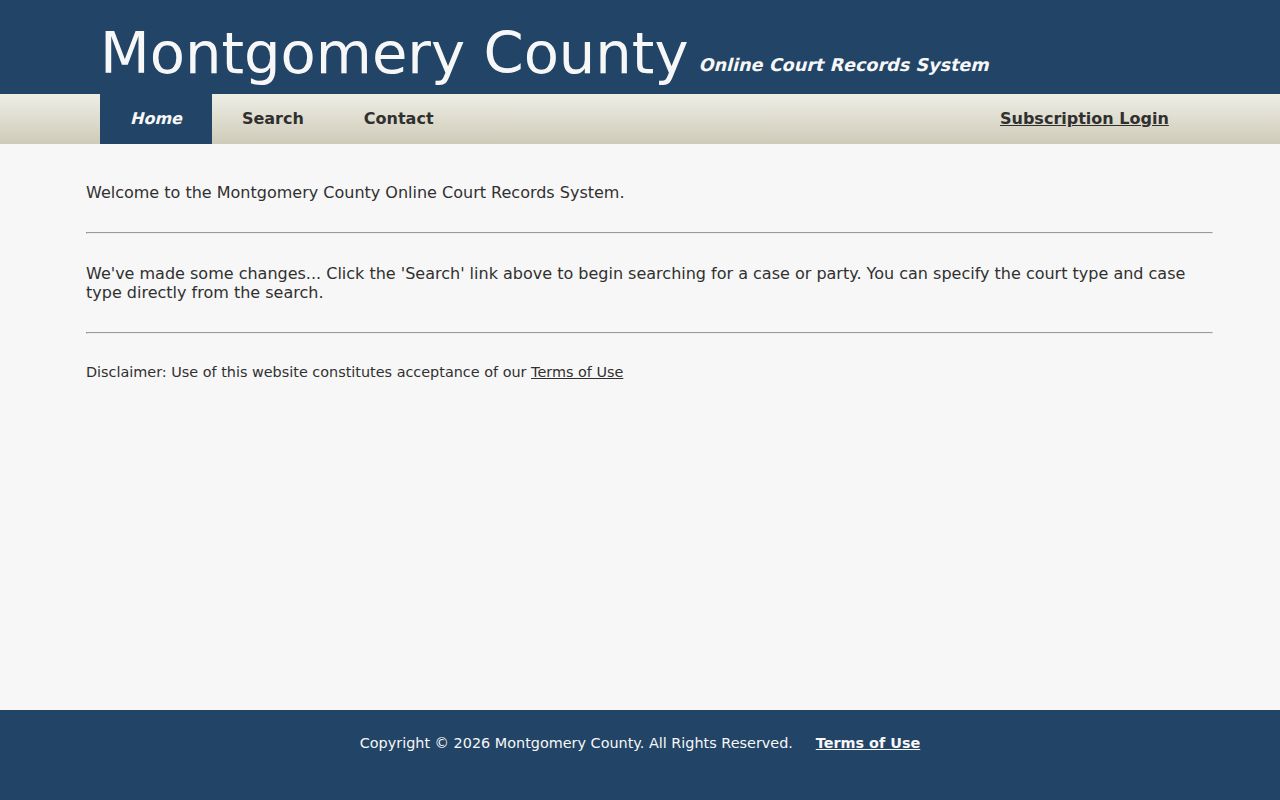
If the file predates online coverage or a needed order is not posted, ask Suite 115 staff to locate the clerk-held record and explain available copy options.
Note: The clerk's search is free, but research did not establish a current Montgomery County certified-copy fee.
Inside a Montgomery County Case File
A case file records the court process, not just the fact of an arrest. The caption and case number identify the proceeding. The charging paper states what was filed. Docket entries form the dated history of appearances, motions, rulings, pleas, and trial activity. The outcome must be read charge by charge because one count can end differently from another.
| Case number and court | Identifies the exact Montgomery County proceeding and division. |
|---|---|
| Charging document | Shows the complaint, information, presentment, or indictment used in court. |
| Docket entries | Lists dated filings, hearings, motions, and orders. |
| Parties and roles | Identifies the accused, prosecution, counsel, judge, and other recorded roles. |
| Disposition and judgment | States how each charge ended and whether guilt was found. |
| Sentence and conditions | Records the court-ordered result when a conviction occurs. |
Financial entries and downloadable documents may also appear when available. For the formal result, use the signed judgment or order rather than a short index label.
Read Montgomery County Court Outcomes Literally
Disposition words carry distinct meanings in Tennessee. A dismissal ends a charge without a conviction. Nolle prosequi, often shortened to “nollied,” means the prosecutor ended that charge. A no true bill means the grand jury declined to indict. An acquittal follows a not-guilty finding. None is the same as a guilty plea or guilty verdict.
- Arraignment
- The formal appearance at which the accused answers the charge.
- Indictment
- A grand-jury accusation that places a felony in Circuit Court.
- Nolle prosequi
- The prosecutor ends the charge without a conviction.
- No true bill
- The grand jury declines to return an indictment.
- Disposition
- The recorded outcome of a charge or case.
A non-conviction outcome may still leave a public arrest trail until a person completes any available expunction process. The Montgomery County court file is therefore the best place to verify how the filed charge ended.
How a Criminal Case Moves
A Montgomery County criminal matter can begin with an arrest and Rule 5 initial appearance in General Sessions. When a preliminary hearing is demanded and available, Tennessee rules set a 14-day period for a jailed person and 30 days for a released person. The prosecutor may then take a felony matter to the grand jury. An indictment brings arraignment and the later Circuit docket.
Case flow: Charges Filed › Arraignment › Pretrial › Plea or Trial › Disposition › Sentencing
Local rules permit closed-circuit arraignment of jail inmates at the court's discretion. After judgment, an appeal can create a new appellate record, but that later file does not replace the Montgomery County trial-court docket.
Montgomery County Court Appeals in C-Track
Tennessee's Public Case History description explains that C-Track is an appellate search. It does not search routine Montgomery County Circuit or General Sessions trials. C-Track accepts an appeal sequence number, a case-style or name fragment, a person's first and last name, or an organization. Its coverage begins September 1, 2006, and data refreshes through the prior business day.
The official Tennessee appellate case-history portal appears below. An appellate result can show the originating court, judge, parties and roles, dated history, motions, orders, opinions, judgments, and available PDFs.
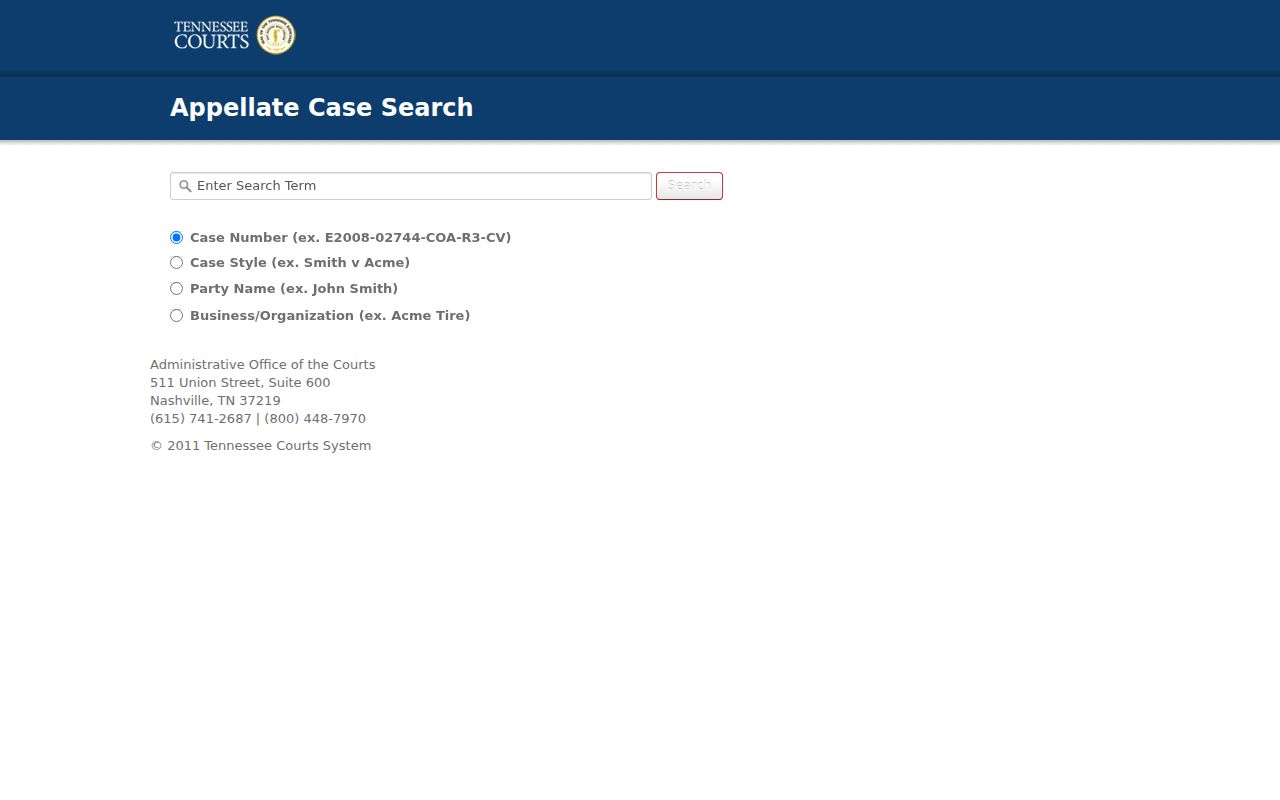
Use C-Track only after an appeal exists. For the original Montgomery County charge and trial result, return to TnCIS or the Circuit Court Clerk.
Case Record Access & Restrictions
Tennessee Supreme Court Rule 34 treats court records as presumptively open, subject to sealing, redaction, and clerk control. Juvenile material is generally restricted. Expunged matters, protected victim or minor information, and sensitive identifiers may also be hidden or removed. An online view can therefore contain less than the clerk-held paper or electronic file without proving that the missing content never existed.
For an older Montgomery County case or certified judgment, use the Circuit Court Clerk contact page or visit the Courts Complex. Staff can route the request to the correct division. Public access does not mean every document is downloadable, and a clerk may need to redact protected fields before release. The District 19 Public Defender profile identifies the defense office, but that office is not the public docket custodian. The broader Montgomery County criminal history overview explains how court files differ from TBI and corrections records.
Federal Court Cases Beyond Montgomery County
A federal prosecution arising in Montgomery County belongs to the Middle District of Tennessee, not county TnCIS. PACER supplies federal dockets and documents after registration. Opinions and courthouse-terminal viewing are free. Other access can carry PACER's published per-page charges and caps. The federal case number or party name is the useful starting point.
The official PACER service is shown below. Its nationwide federal coverage is why a search there should be reserved for federal matters rather than used as a substitute for the Montgomery County clerk.
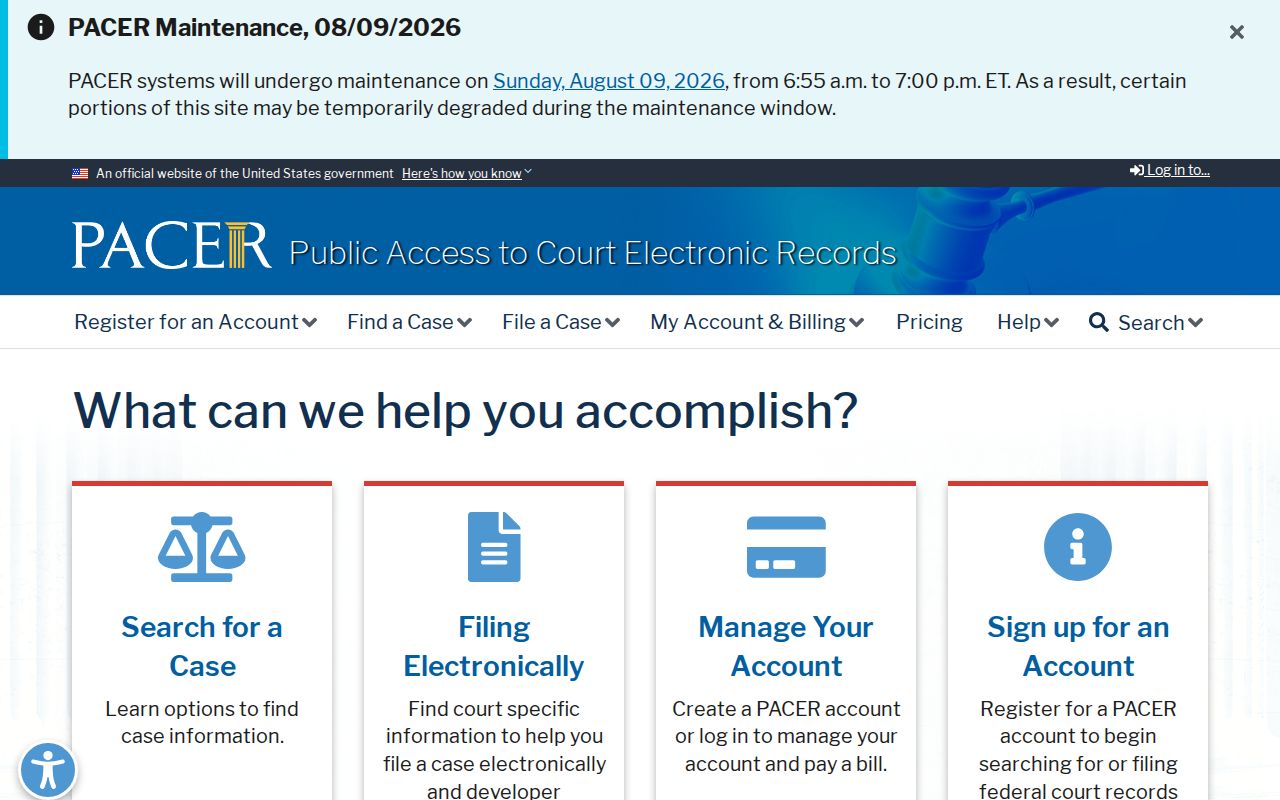
Fort Campbell matters may also involve federal jurisdiction. Check the charging document for the court name before choosing between PACER and the county system. The Bureau of Prisons locator is the separate federal custody channel and does not search the Montgomery County jail.
That Montgomery County court choice keeps a federal docket from being mistaken for the local criminal court record.