
Sex Offender Checks in Montgomery County
The Tennessee Sex Offender Registry is the main public search channel for Montgomery County. TBI operates it at no charge and says the information is updated daily from data supplied by registering agencies. Begin there for a name or place search. The separate state map adds a location view, while the Montgomery County Sheriff's registration unit explains who reports locally. These tools answer related questions, but none replaces the full profile or direct agency confirmation.
A careful check uses more than one identifier. Compare the name, aliases, photograph, date of birth, physical description, TID number, status, and registering agency before drawing a conclusion. The record may also show several registered addresses or a supervision office. If a field reads “Not Available,” TBI has not received the directed data. It does not mean the fact does not exist. A blank search also cannot prove that a person has no registration duty, because public visibility and law-enforcement registry data are not identical.
Montgomery County readers should reopen the live state record whenever time has passed since an earlier check.
Montgomery Registry Data Changes Daily
The TBI registry information page explains the system's update cycle, status terms, reporting rules, and limits. Its captured view is shown below as an official starting point for interpreting Montgomery County registry records.
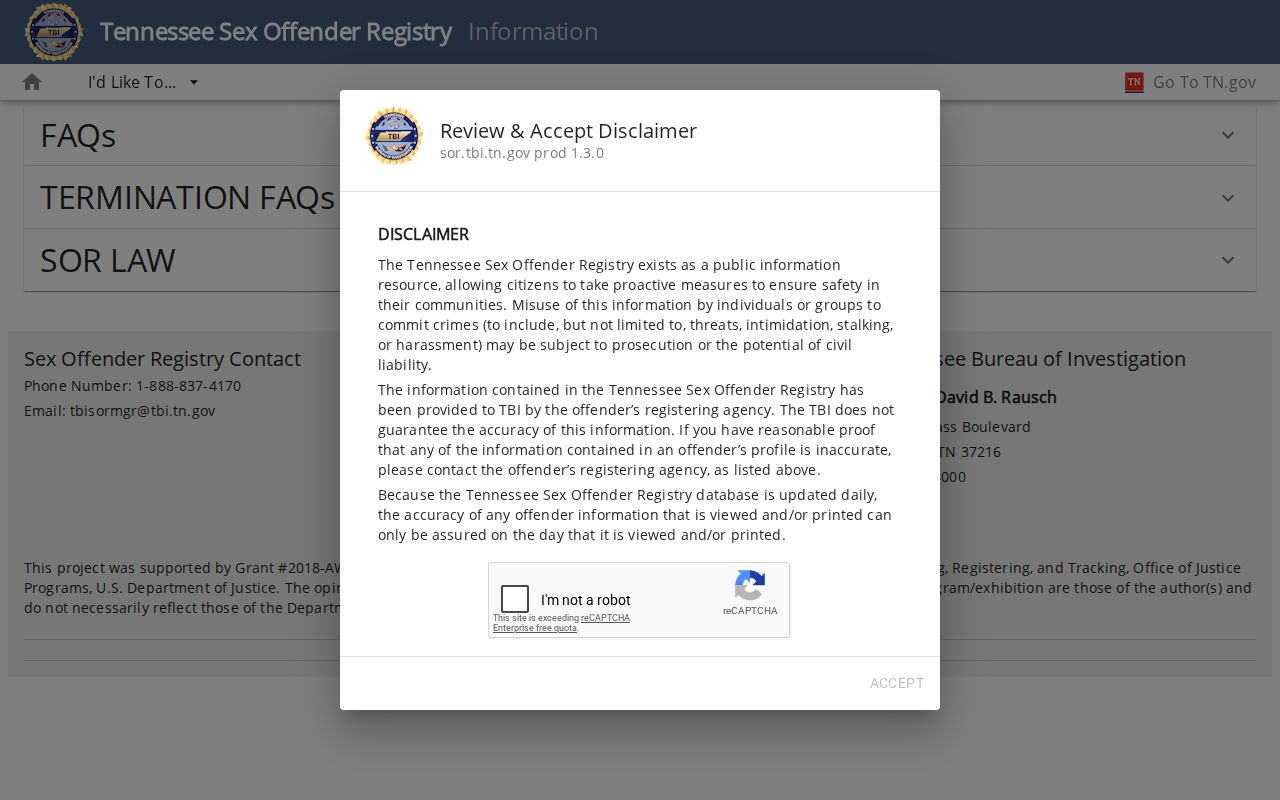
The information screen matters because a result is only as current as the reporting and update fields on the profile. TBI says the accuracy of a viewed or printed record is assured only on the day it is viewed. Save the date of review, then reopen the official profile for a later decision. Status labels also require context. Active, absconder, inactive-incarcerated, inactive-moved to another state, and other program terms describe registry status rather than a fresh finding of guilt.
When data looks wrong, contact the registering agency shown in the record and provide reasonable proof. TBI administers the centralized registry at 1-888-837-4170 and tbisormgr@tbi.tn.gov, but the local agency may hold the newest source record. This two-step route is more useful than guessing why an address, report date, or status has not changed.
How to Search the Tennessee Sex Offender Registry
Use the most reliable information already known. A county filter keeps results within Montgomery County, while city and ZIP fields narrow the geographic scope. TID is the strongest registry-specific identifier when available. The official map is a separate channel, so the ordinary search does not require a radius value.
- Open the TBI information page, read the warning, and continue to the registry search.
- Enter a name, place field, or TID. Use Montgomery in the county field for county-wide results.
- Compare the result list by photograph, aliases, date of birth, and physical descriptors.
- Open the full profile and read its status, report date, update date, agency, addresses, and offense rows.
| Field label | Type | Required | Use |
|---|---|---|---|
| Last Name | Text | Not stated | Search a known surname |
| First Name | Text | Not stated | Narrow a name result |
| City | Place field | No | Narrow within a city |
| County | Place field | No | Choose Montgomery County |
| ZIP Code | Text | No | Narrow by reported ZIP |
| TID Number | Identifier | No | Match a known registry ID |
Montgomery Offender Map and NSOPW
Tennessee offers an official registry map for spatial review. The manifest capture below shows that distinct state channel. A plotted point helps with community awareness, but it does not decide whether a person complies with Tennessee's property-line restrictions.
The map should lead back to the full TBI profile. Open the profile to check the address type, registering agency, last report, and last update. Tennessee's official sources did not expose exact public radius controls during research, so no unverified radius is promised here.
For a search that crosses state lines, use the National Sex Offender Public Website. The federal portal brings participating jurisdictions into one search layer, as shown in the captured official page below.
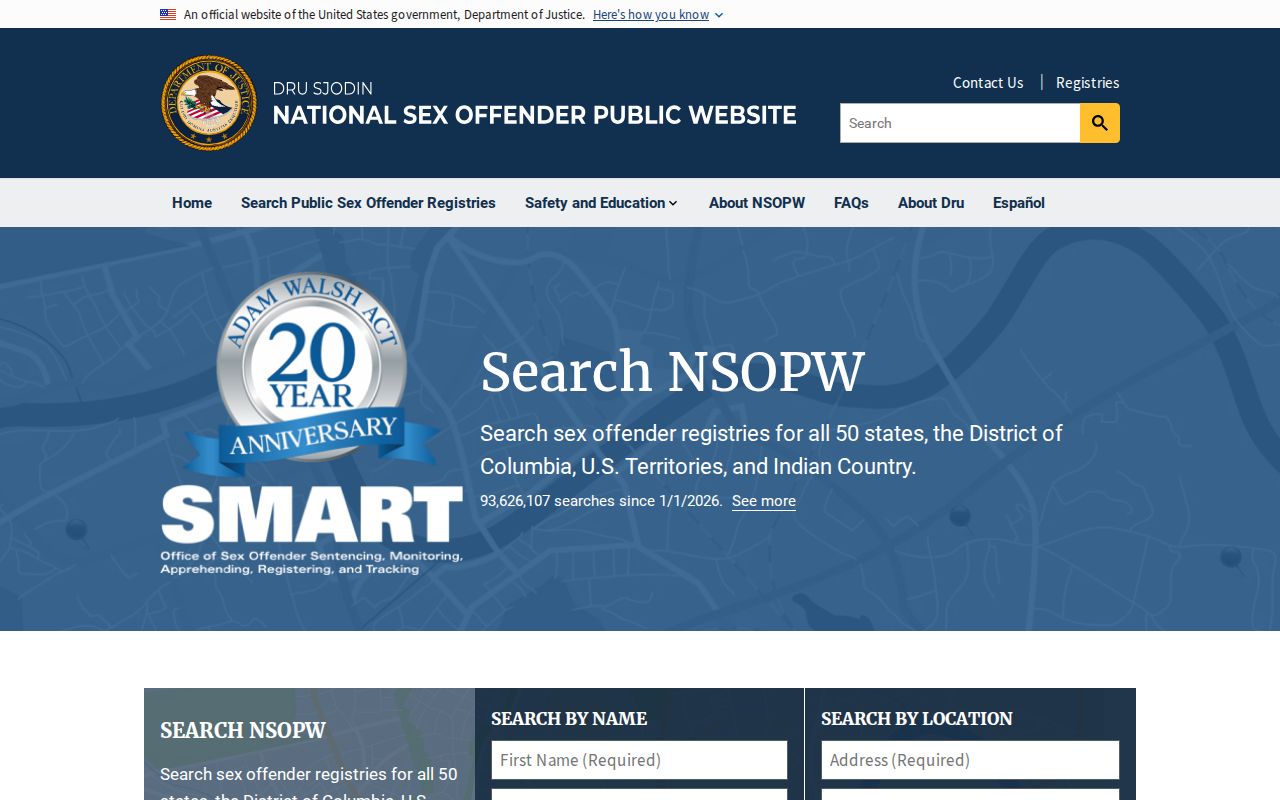
NSOPW is useful when a known address or past residence falls outside Tennessee. It is not a replacement for the Tennessee profile. State fields, local registering-agency contacts, and Tennessee reporting language are best checked in TBI's own record.
Inside a Registry Profile
A profile separates identity clues, reported locations, program status, and offense history. Read each group on its own terms. Registration can continue apart from current probation or parole, so a supervision field should not be treated as the registry status itself. Offense rows may include the offense date, description, Tennessee statute, embedded statutory text, and other disposition history when populated.
| Name and TID | Primary name, aliases, and the Tennessee registry identifier. |
|---|---|
| Photo and description | Photograph, date of birth, hair, eyes, gender, race, height, weight, scars, marks, and tattoos. |
| Reported locations | Full registered addresses plus employment, school, or higher-education fields when populated. |
| License details | Driver license number and issuing state when supplied. |
| Program status | Classification, current status, last registration or report date, last update, and registering agency. |
| Offense record | Offense date, description, statute, statutory text, and related history rows when available. |
Use recency fields to judge what needs confirmation. “Information Updated” is a reporting type, while “Active” is a status. “Inactive-Incarcerated” does not mean the qualifying record vanished. A reasonable match still needs confirmation through the agency shown on the official profile.
Montgomery Offender Registration at Commerce
The Montgomery County Sheriff's registry unit registers people living in the county who are not on state probation. The official county unit page appears in the captured image below.
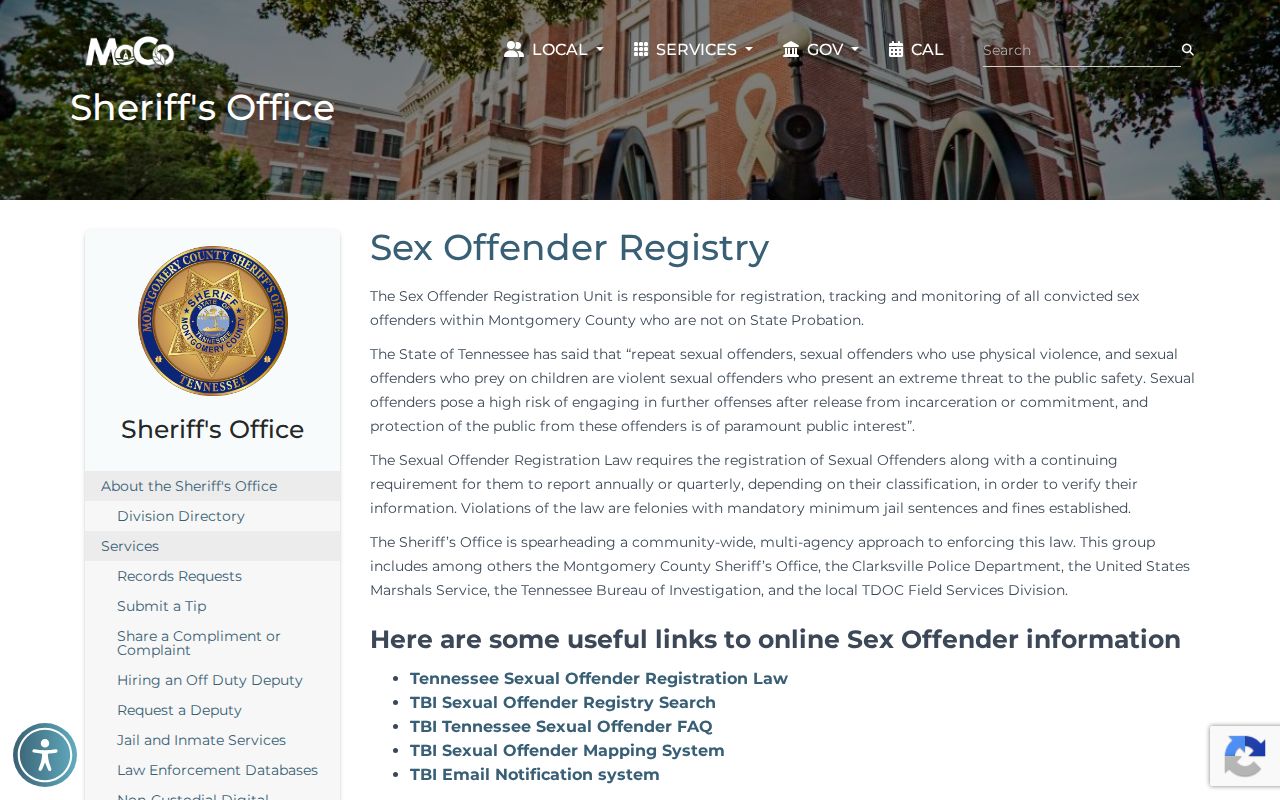
The unit is at 120 Commerce in Clarksville. Investigator Mckenzie Knotts can be reached at 931-648-0611 extension 13200, and Deputy Roxanne Johnson at extension 13218. The sheriff does not publish a local fee, appointment rule, or walk-in schedule, so call before arriving. The MCSO department page and Montgomery County directory provide official fallback routes if a division page moves. People under state supervision register through the Tennessee Department of Correction instead. That local-versus-state split is vital when a correction or suspected reporting problem needs the right office.
Montgomery County also describes joint enforcement work involving the sheriff, Clarksville Police, U.S. Marshals, TBI, and TDOC Field Services. Suspected noncompliance should go to the proper registering agency. Do not confront anyone or post an accusation based on a possible match.
Tennessee Registration Levels and Requirements
Tennessee does not use the public federal Tier I, Tier II, and Tier III scheme. Its registry uses “sexual offender” and “violent sexual offender,” with statutory categories that also include violent juvenile sexual offenders and offenders against children. Importing a generic tier chart would misstate Tennessee law.
| Tennessee classification | Verification | Duration concept |
|---|---|---|
| Sexual offender | Annual, around the birthday window | A termination request may be possible after ten years if TCA §40-39-207 conditions are met |
| Violent sexual offender | Quarterly in March, June, September, and December | Violent or lifetime offenses generally remain for life |
| Violent juvenile sexual offender | Statutory juvenile rules | May not appear on the public site |
Both main classifications must report changes in required information in person within 48 hours. TBI guidance gives a 72-hour change period for online identifiers such as email addresses or screen names. A conviction date alone does not establish that the duty has ended.
Montgomery Registry Termination Requests
Ten years is not an automatic removal date. Under TCA §40-39-207, a non-lifetime sexual offender may request termination after the statutory period, but exclusions, compliance, and later-record review control the result. Violent and lifetime categories generally remain for life. The public profile should not be read as a countdown clock.
A qualifying expunction order can remove a registry record under TCA §40-39-209 only when the offense is eligible and the order applies. Other absences may reflect an overturned conviction, a terminated registration duty, a nonqualifying offense, a move, death, deportation, incarceration, or another legal fact. The absence of a public result is not grounds to publish a claim about a person.
For a record that seems stale, start with the registering agency listed on the profile. TBI handles central administration, while the sheriff or TDOC may hold the source update. This preserves a clear audit trail.
Montgomery Registry Property-Line Rules
TCA §40-39-211 establishes Tennessee's 1,000-foot restrictions for specified properties and uses property-line measurements. A map pin alone cannot resolve compliance. The statute includes details and exceptions, including facts about an established residence or work situation when nearby property ownership or use later changes.
Violations can carry a Class E felony classification and statutory minimum consequences. Those stakes call for agency or legal confirmation, not a ruler placed on a public map. Searchers should report a reasonable concern to the Montgomery County unit, TDOC when state supervision applies, or TBI's registry administration. Community awareness does not grant enforcement power.
Note: Public map locations are search aids, not final legal findings about a person's compliance with Tennessee property-line restrictions.
Community Notification and Lawful Use
Registry information supports personal, family, and neighborhood safety. Read the current profile, note the registering agency and date, and use official contacts for a sound concern. TBI warns that data comes from registering agencies and does not guarantee its accuracy. A possible name match should never be turned into public accusation, confrontation, or private punishment.
Threats, intimidation, stalking, and harassment can lead to criminal prosecution or civil liability. Tennessee's registration law also imposes serious duties and penalties under TCA §40-39-211, but members of the public do not decide whether those duties were breached.
Use registry information lawfully: TBI warns against threats, intimidation, stalking, or harassment. Misuse can bring prosecution or civil liability. Review TCA §40-39-211 and report concerns to the registering agency instead of acting on them.
For a Montgomery County concern, call the sheriff's unit. For a person under state supervision, contact TDOC. For central registry questions, use TBI's hotline or email. These routes protect both community safety and record accuracy.